Flood and Earthquake Proof Industries: Japan's Functional Insights For Assam
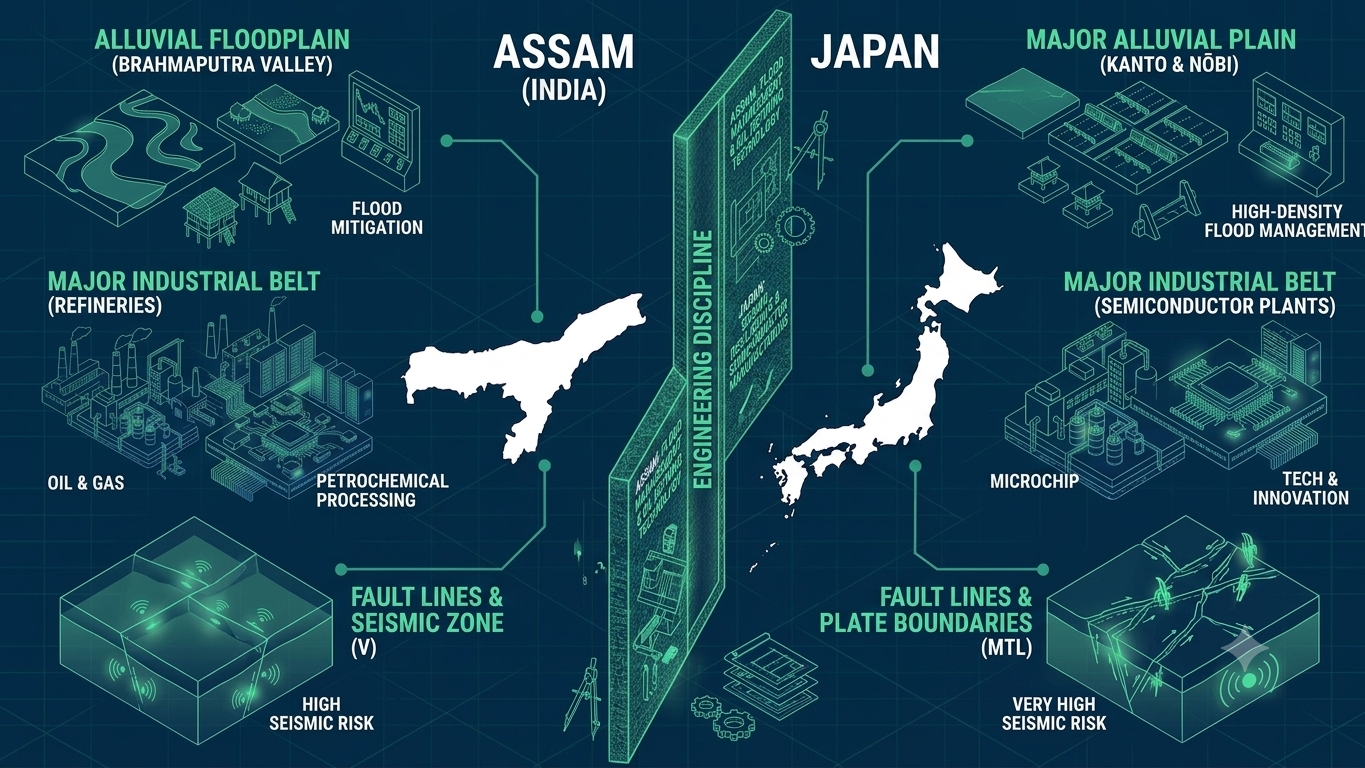
Japan and Assam share the hazard profile: fault lines under the industrial belt, monsoon or typhoon floods across the plain, alluvial ground that liquefies under an earthquake. But Japan is an industrial superpower, thanks in part to rigorous engineering discipline. Some insights for Assam to replicate
0 of 10 sections read
Japan is the world’s third-largest industrial economy. It also occupies some of the most seismically active land on the planet, located at the junction of four tectonic plates, hit by seven typhoons a year on average, and battered by the Mw 9.1 Tohoku earthquake in 2011 and the Mw 6.9 Kobe earthquake in 1995.
On paper, Japan shouldn’t have any industries. Advanced manufacturing needs stable ground, uninterrupted power, and predictable logistics. Japan has none of those things by default. It engineered them.
Assam has the same hazard profile:
- Assam falls entirely within IS 1893 Seismic Zone V, India’s highest hazard band.
- The 1897 Assam earthquake, estimated at Mw 8.1, produced widespread liquefaction along the Brahmaputra.
- The Kopili, Dhubri and Oldham faults run under the industrial belt.
- The 2026 monsoon killed 100+ people, disrupted ONGC workover operations at Nazira on 19 July, and forced APDCL to disconnect 619 transformers.
What Assam does not have, yet, is the codified engineering discipline that lets Japan operate a Rs 27,000 crore semiconductor plant on ground that behaves like liquid under a design earthquake.
This report covers:
- The Assam-Japan hazard comparison, with numbers (Section 2)
- BCM (Business Continuity Management) as a management system, not a binder (Section 3)
- The 1981 two-phase seismic design doctrine and what enforcement means (Section 4)
- JBDPA carbon-fibre retrofit, priced per column for existing MSMEs (Section 5)
- IIT Guwahati’s liquefaction research and its foundation-cost implications (Section 6)
- The pipeline corridor: DAS sensors, block valves, and who pays (Section 7)
- The University of Tokyo’s 32-hour flood forecast and the transfer path (Section 8)
- The full MSME and state cost stack in one table (Section 9)
- Five state-level actions, each with an owner and a horizon (Section 10)
Who should read this: industrial promoters, lenders, and policymakers with capital at risk in Assam’s manufacturing, energy, or agro-processing base. Every recommendation has a source. Every number has a range.
We covered Japan’s engagement with Assam in our June 2026 analysis of the cancelled Guwahati visit and the July 2026 aftermath piece on the Delhi summit deliverables.
The Assam-Japan comparison is not a metaphor. It is a table.
| Dimension | Assam | Japan |
|---|---|---|
| Seismic zone | IS 1893 Zone V (highest) | JMA active zones, plate-junction |
| Historic max earthquake | 1897 Great Assam, Mw 8.1 | 2011 Tohoku, Mw 9.1 |
| Active faults under industry | Kopili, Dhubri, Oldham | Median Tectonic Line, Nankai Trough |
| Modelled max event (nearest fault) | Mw 7.3 to 7.5, Kopili | Mw 9.0+, Nankai megathrust |
| Alluvial ground | Brahmaputra sand and silt, deep | Kanto plain, deep |
| Monsoon or typhoon season | June to September | August to October |
| Recent named flood | 2026 monsoon, 100 deaths | Typhoon Hagibis 2019, 142 dikes breached, 86 deaths |
| Anchor industry on flood plain | 4 refineries, TSAT Rs 27,000 cr | Kashima petrochemical, Tohoku manufacturing |
| Building code | IS 1893:2016 (mirrors Japan 1981) | Building Standard Law (1981, revised 2000) |
| BCP adoption, large firms | Not measured, likely under 10% | 76.4% by 2023 |
| Nationwide flood forecast | CWC gauge readings, 3-6h lead time | TE-Japan, 32h average lead time |
| GDP per capita | ~USD 1,600 | ~USD 40,000 |
The hazard profile matches, but the response maturity does not. The gap is 45 years of discipline, and roughly 20x the GDP per capita to fund it. Neither is copyable in a decade, but the method certainly is.
The insight. The hazard is not the constraint on Assam’s industrialisation. The response discipline is. Japan proves that a Zone V equivalent country can host anchor semiconductor investment. What separates both is the rulebook and 45 years of retrofit debt.
Most Indian factories that claim a Business Continuity Plan have a document. Japan treats business continuity as a management system.
The Cabinet Office of Japan’s Business Continuity Guidelines, Third Edition, first issued in English in 2014 and updated in Japanese in 2023, define BCM as a continuous PDCA cycle owned by the top of the organisation. The BCP is one output. A binder in a cupboard fails the test.
The concept the guidelines add to Indian practice: paired RTO and RLO.
- RTO is the target time to resume any level of operations after a disruption.
- RLO is the percentage capacity at which those operations must resume within the RTO.
A refinery aiming to restart in 48 hours (RTO) at 60% throughput (RLO) is a specific commitment. A refinery aiming to restart “as soon as possible” is not.
For the Rs 27,000 crore Tata Semiconductor plant at Jagiroad, the state’s incentive package should specify both numbers. An RTO of 72 hours after a design-flood event, at an RLO of 40% wafer throughput, is a number a regulator can audit and a designer can build to. “Best effort resumption” is a number that gets litigated after the loss.
Japan learned this the hard way. Fifteen years after the Mw 9.1 Tohoku earthquake and the Fukushima nuclear accident, the response discipline has become the export product. This video gives some insights:
What Assam should mandate.
- BCM certification for every anchor investment above Rs 100 crore that draws the Mega customised package under the Industrial and Investment Policy of Assam 2019.
- BCM certification for every lifeline operator (power, refined product pipeline, gas transmission, water) that holds an operating licence in the state.
- Paired RTO and RLO disclosure as a condition of the operating licence.
What it costs the state: almost nothing. The document is already in English on the Bousai site.
What it costs an MSME: a workable BCP for a Rs 5 to 15 crore manufacturing unit costs Rs 40,000 to Rs 1.5 lakh with a consultant, plus 20 to 40 hours of management time.
The target. Japan reached 76.4% large-firm BCP adoption by 2023. A realistic Assam target: 100% of lifeline operators within three years; 50% of Rs 10 crore-plus manufacturers within five.
Japan’s 1981 revision to the Building Standard Law codified two-phase seismic design. IS 1893 borrows the same logic. What Japan added, and what India lags on, is the peer-review discipline that makes the code enforceable.
Phase 1: allowable stress design. Targets the moderate earthquake the structure will see multiple times in its life. Design objective: safety and serviceability. Structural elements must stay in the elastic range with Zero damage. Normal functioning resumes as soon as possible.
Phase 2: ultimate lateral load capacity. Targets the severe event, roughly the 500-year return period. Design objective: ductility and collapse prevention. The structure is allowed to yield and deform and life is protected. The building may be decommissioned.
The 2000 revision. Moved from prescriptive rules to performance-based design. Engineers can specify base isolation, viscous dampers, and composite systems, provided the response is calculated and verified.
What Assam should mandate.
- Third-party seismic peer review for any new industrial construction in a Zone V district with FCI above Rs 5 crore.
- Site-specific response spectra for anchor investments above Rs 100 crore, replacing the generic IS 1893 spectrum.
- Base isolation as default for cleanroom-grade facilities and lifeline control rooms above a threshold value. Base isolation adds 10-15% to structural cost and cuts equipment-level acceleration by a factor of three to five.
MSME budget. Peer review adds Rs 50,000 to Rs 3 lakh for a single-block industrial building. On a Rs 5 crore project, that is 0.01% to 0.06% of capital cost. The state’s existing IIPA 2019 subsidy stack reimburses 75% of BIS/ISO/ZED certification up to Rs 10 lakh. A parallel line for seismic peer review costs the exchequer nothing meaningful and changes the risk profile of the entire pipeline.
Most operating industrial buildings in Assam predate any meaningful seismic enforcement. Refineries at Digboi and Guwahati, tea factories across Upper Assam, and the packaging and CNC-machining MSME base around Guwahati use structures designed to older codes or to no seismic code at all. Retrofit, not demolition, is the only feasible answer.
Japan faced the identical problem after the 1995 Kobe earthquake. The response was a codified methodology from the Japan Building Disaster Prevention Association (JBDPA) using Fibre Reinforced Polymer wrapping.
How it works.
- Continuous sheets of carbon fibre (CFRP) or aramid fibre (AFRP), 0.11 to 0.33 mm thick, are wrapped around a deficient column.
- The wrap is bonded with a two-part epoxy resin.
- The confined concrete gains shear capacity and ductility without meaningful dead weight added.
- An IIT Kanpur study documented order-of-magnitude gains in energy dissipation under reverse cyclic loading versus unwrapped controls.
The special provision that matters for MSMEs. Standard retrofit chips columns down to bare concrete: dust, noise, vibration, shutdown. JBDPA permits application directly over existing finishing mortar, subject to four conditions:
- Mortar thickness must not exceed one-fifteenth of the column’s largest dimension (t_m ≤ D/15).
- In-situ bond strength of the mortar to the concrete core must be at least 1 MPa.
- Existing cracks must be pressure-injected with epoxy before wrapping.
- Longitudinal overlap of the FRP sheet must be at least 200 mm to prevent debonding.
Column corners must be rounded: radius ≥ 20 mm for CFRP, ≥ 10 mm for AFRP.
Indian market pricing.
- Rs 15,000 to Rs 45,000 per running metre for a 300 mm square RC column.
- A single-storey industrial shed with 30 columns at 4 metres: Rs 18 lakh to Rs 54 lakh total.
- Suppliers active in India include Sika, BASF, Fyfe and Weber Saint-Gobain.
The MSME decision is not FRP versus RC jacketing on material cost. It is FRP with production continuity versus RC jacketing with 4-6 weeks of shutdown. At Rs 3-8 lakh per week of gross margin for a mid-scale unit, the shutdown alone often exceeds the material saving.
The subsidy path. FRP retrofit fits naturally as a new eligible line under the IIPA 2019 “Other Incentives” cap of 100% of FCI. No new fiscal ceiling required.
IS 1893 protects the structure above ground. It says nothing about what happens to the ground itself.
Prof T.G. Sitharam’s group at IIT Guwahati’s Centre for Disaster Management and Research has spent two decades mapping the seismic behaviour of Assam sands. The finding for any industrial foundation on Brahmaputra alluvium: the in-situ cyclic shear strength is exceptionally low.
What liquefaction is, in one paragraph. Under earthquake loading, pore water pressure in loose saturated sand rises until it equals overburden pressure. Effective stress drops to zero. The soil loses shear strength and flows. Foundations tilt, settle, and can move laterally toward the nearest free face, typically a riverbank.
For a visual explanation, the NHK WORLD-JAPAN “Navigating Disasters” series episode on “Soft Soil: The Hidden Threat Below the Ground” walks through the mechanism at length. Grady Hillhouse’s Practical Engineering channel has built the definitive layperson explanation of soil mechanics.
Several of the high-susceptibility zones map directly onto Guwahati’s MSME corridor. Any Rs 2 to 15 crore manufacturing unit taking land in G.S. Road, Chandmari, or the airport belt should assume a liquefaction-competent foundation as the base case, not an optional upgrade.
Three foundation options for a liquefiable site:
- Densify the soil. Vibro-replacement stone columns compact loose sand and provide drainage. Rs 800-2,500 per running metre. Rs 15-40 lakh for a 500 sq m industrial pad.
- Bypass the layer. Deep piles bored down to Precambrian bedrock, 15-30 metres below grade in Guwahati. Rs 40 lakh to Rs 1.5 crore for a small industrial building.
- Isolate the structure. Base isolation for the superstructure only. Does not address underlying ground failure.
What the state should fund. Full seismic microzonation at revenue-circle resolution for every industrial estate in a Zone V district, starting with Guwahati and Jorhat. Rs 30 lakh to Rs 1 crore per city. Feeds directly into building approvals and land-allotment terms.
Assam is a national energy corridor. It is also a fault-crossing corridor.
Three active seismic sources cut across the automated pipeline network laid from 1962:
- The Kopili Fault. Strike-slip zone, 300-400 km long and 50-100 km wide. Crossed by the Naharkatiya-Noonmati crude line and the Numaligarh-Siliguri product line. Produced a Mw 6.1 event at Sonitpur in April 2021. Physics-based simulations model a maximum credible magnitude of Mw 7.3 to 7.5.
- The Dhubri Fault. North-south trending. Crossed by the Noonmati-Barauni crude line and the upcoming GAIL Barauni-Guwahati natural gas pipeline.
- The Oldham Fault. Close to the Dhubri. Associated with the 1897 Mw 8.1 source.
The unmeasured exposure. None of these lines has been tested by a magnitude 7-plus event since they were built. The subsurface response of 60-year-old steel to a Kopili Mw 7.3 rupture is theoretical, with no way of knowing what will actually happen.
What a rupture at a river crossing triggers. Peer-reviewed vulnerability assessments of the Guwahati pipeline network sequence the cascade:
- Crude spill directly into the Brahmaputra.
- Loss of primary hydrocarbon supply to refineries in Assam, West Bengal and Bihar.
- Ignition risk. The 1994 Northridge earthquake ruptured municipal gas lines and started 110 simultaneous fires across the San Fernando Valley. Guwahati has five active fire stations for a population above one million.
Japan’s three-part fix, standard on Pacific Rim earthquake pipeline codes.
- Flexible high-ductility joints (expansion loops, ball joints) at fault crossings, absorbing multi-axial displacement without steel rupture.
- Automatic seismic block valves, triggered by peak ground acceleration threshold, isolating the ruptured segment within seconds.
- Distributed acoustic sensing (DAS). Fibre-optic cables laid alongside the pipe monitor strain continuously. The Trans-Alaska Pipeline’s DAS system detects sub-millimetre ground deformation.
The Assam price tag.
- DAS installation: USD 5,000-15,000 per km of pipeline plus a monitoring contract.
- Automatic block valves at fault-line crossings: USD 100,000-500,000 per valve installed.
- Full hardening across Assam’s three fault crossings, roughly 400 km of high-risk pipeline: Rs 150-400 crore, distributed across Oil India, ONGC, GAIL and Indian Oil.
Rs 400 crore is the ceiling estimate. It is 1.5% of the Rs 27,000 crore Tata Semiconductor investment, and one bad year of statewide flood losses. On any accounting basis, this is a mandatory item.
Who mandates it. The lines are inter-state assets regulated by the Petroleum and Natural Gas Regulatory Board (PNGRB). Assam’s role is a formal request to PNGRB to require DAS deployment and seismic block valves as a licence condition for any operator crossing the three faults. The state is not the funder. It is the party best placed to make the ask.
Current Indian flood warning practice for the Brahmaputra basin gives industrial operators a few hours’ notice at best. That is enough time to move personnel and lock out electrical equipment.
It is not enough time to:
- Shut a semiconductor wafer line down cleanly (72+ hours ideal, 32 hours workable).
- Execute a controlled refinery flare-and-shutdown sequence (24-48 hours).
- Complete a cold-chain relocation for a food processing MSME.
For those assets, the difference between 3 hours and 32 hours separates graceful shutdown from forced restart with damaged equipment.
Today’s Earth Japan (TE-Japan). A flood early warning model, developed jointly by the Institute of Industrial Science at the University of Tokyo and JAXA could be the answer. It’s built on satellite precipitation observations, surface meteorology, and a coupled land-surface river-routing model. The validation study, published in Scientific Reports in 2021, tested predictions against actual dike-break locations during Typhoon Hagibis (October 2019, 142 dikes breached).
Results:
- 91.6% accuracy at predicting the location of flooded dike-break points.
- 32.75 hours of average lead time on true-positive predictions.
- Near-real-time output publicly available via JAXA.
The Brahmaputra deployment path.
- The transfer channel exists. JICA runs a three-year training project (2024-2026) with CDMR at IIT Guwahati. The May 2025 batch trained in Nagano and Kanagawa on river basin management.
- The Indian gauge network is upgrading. The Union Home Minister launched the Integrated Control Room for Emergency Response and NDEM Lite 2.0 at Guwahati in June 2025. The Assam government-IIT Guwahati MTech in Flood and Water Resources Management is building the human capacity.
What is missing. A specific bilateral request. Assam should ask the Ministry of External Affairs, through the India-Japan Act East Forum, to prioritise TE-Japan adaptation for the Brahmaputra basin as a named joint project, with validation targeted against the 2027 monsoon.
Cost. Rs 15-40 crore, two-year project. 0.06-0.15% of the Tata Semiconductor package. Zero-controversy line item on a state-fiscal basis.
Every figure below is a working estimate. Precise numbers depend on site, vendor, and phasing. Use these to size the decision.
MSME cost ladder (Rs 5-15 crore manufacturer):
| Action | Indicative cost | Subsidy path |
|---|---|---|
| Bhuvan flood atlas check | Rs 0 | n/a |
| CWC alerts + trigger-based SOP | Rs 0-5,000 | n/a |
| BCP with RTO + RLO | Rs 40,000-1.5 lakh | IIPA Quality Cert. line |
| Third-party seismic peer review | Rs 50,000-3 lakh | Propose new line |
| Site-specific H&H flood study | Rs 1.5-5 lakh | Not currently subsidised |
| Critical utility elevation + backup | Rs 5-25 lakh | IIPA Power subsidy |
| FRP retrofit per structural bay (~30 columns) | Rs 18-54 lakh | Propose new line |
| Wet/dry floodproofing retrofit | Rs 10-40 lakh | Not currently subsidised |
| Liquefaction-competent foundation | Rs 15 lakh-1.5 crore | Capex, self-funded |
| Base isolation (critical assets) | +10-15% on structural cost | Anchor-tier only |
Three observations from the stack.
- The first three lines cost less than Rs 1.55 lakh combined. Atlas check, SOP, and BCP. No MSME in Assam has a justifiable reason not to complete these within 90 days. The rebuilt Nitisagar subsidy calculator prices the incentive side.
- The middle band (Rs 5-50 lakh) needs a subsidy structure adjustment, not new fiscal outlay. Utility elevation, FRP retrofit, floodproofing fit inside the IIPA 2019 “Other Incentives” cap of 100% of FCI. Two new eligible lines close the gap.
- State-side items are cheap relative to the anchor incentives they enable. Guwahati microzonation is a rounding error against the Rs 3,789 crore state package for Tata Semiconductor. TE-Japan adaptation is smaller still.
The window. The Tata Semiconductor plant at Jagiroad enters commercial production in the current financial year. Assam’s four refineries and the pipeline corridor have operated for six decades without a Mw 7-plus test. The state has funded JICA training, a flood-engineering MTech, and an integrated emergency control room. The pieces are on the table.
The transition. Assembling them is a rule-making exercise. It is not a spending exercise. Japan spent 45 years building the discipline after Kobe and Fukushima. Assam does not have that long. One monsoon at a time.
For MSMEs, the first three lines of the cost stack (atlas check, SOP, BCP) cost less than one week of production and can be completed in 90 days. Every column that gets wrapped, every pipeline sensor installed, every isolation valve commissioned, is a decade of asset life earned back.
The moves that matter, before they cost you
Reports like this one are how we go deep on the shifts that decide which projects work in Northeast India. Every new report, briefing, and analysis in your inbox — original reporting, no syndicated fluff.
We'll map your project against IIPA 2019 and Assam's incentive stack, complimentary, no commitment.
Get a Free Pre-Assessment