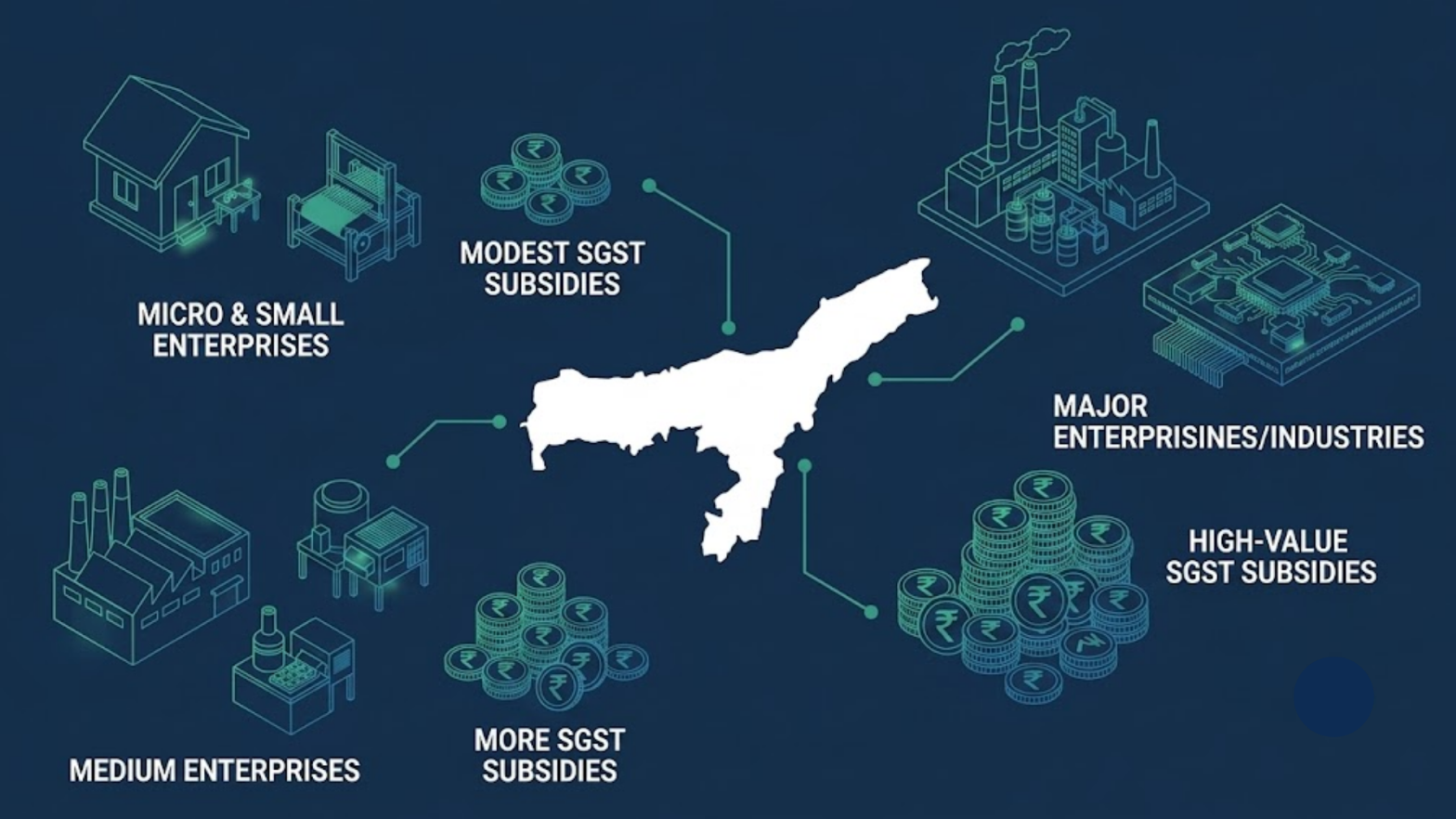
In Assam, industries pick a factory site by district. They believe a Zone A, Zone B or Zone C grid decides the subsidy. The Industrial and Investment Policy of Assam, 2019 (IIPA 2019) has no such grid.
IIPA 2019 sets every incentive by enterprise size: Micro, Small, Medium, Large or Mega. District plays no part in the calculation.
The classification axis is size, not geography
The policy was notified by the Assam government on 30 July 2019. It was extended indefinitely from 1 September 2024. Neither document contains a district table.
One variable moves the SGST cap and the Other Incentives ceiling:
- Micro
- Small
- Medium
- Large: over Rs 10 crore in plant and machinery
- Mega: over Rs 100 crore, or 200 or more regular employees
Micro, Small and Medium follow the MSMED Act’s investment-and-turnover test, revised nationally from 1 April 2025: Micro up to Rs 2.5 crore, Small up to Rs 25 crore, Medium up to Rs 125 crore. IIPA 2019’s Large and Mega thresholds are the state policy’s own fixed figures. They do not move with that revision.
Where the zone myth comes from
The zone idea is not invented. It belongs to a different scheme. UNNATI 2024, a central capital-investment scheme, runs two zones: Zone A at 30% of eligible plant and machinery, Zone B at 50%. Founders carry that structure over to IIPA 2019 by habit.
The two schemes are unrelated. UNNATI is also functionally closed to new applicants, as covered in our Assam Budget 2026-27 analysis. IIPA 2019 stays the live state scheme regardless, and it has never run a district grid.
The same unit, two districts, identical numbers
Take two identical Small enterprises. Each has Rs 5 crore in fixed capital investment (FCI). Neither sits inside a declared industrial park. One is in Kamrup Metropolitan. The other is in Dhemaji.
| Parameter | Kamrup Metropolitan | Dhemaji |
|---|---|---|
| Enterprise category | Small | Small |
| SGST reimbursement rate | 100% via cash ledger | 100% via cash ledger |
| SGST cap, 15 years | 150% of FCI = Rs 7.5 crore | 150% of FCI = Rs 7.5 crore |
| Other Incentives cap | 100% of FCI = Rs 5 crore | 100% of FCI = Rs 5 crore |
| District adjustment | None | None |
IIPA 2019 does not read the pin code. It reads the enterprise category.
The one real exception (not a district)
The SGST cap does rise for units inside a declared industrial park. That is a park-membership rule, not a district rule.
- Micro units outside a park: 200% of FCI. Inside a Plastic, Bamboo, Food, Tea or other government-collaborated park: 250%.
- Small units outside a park: 150% of FCI. Inside a park: 180%.
Several such parks are located across different districts. A Small unit outside any park draws 150% whether it is in Kamrup Metro, Dhemaji, or anywhere else in the state.
What should actually decide your site
Since the subsidy rate stays flat, four other variables carry the real weight:
- Land cost and acquisition timelines, which vary sharply by district. Our AIDC TEFR guide covers the feasibility documentation AIDC requires before it allocates land.
- APDCL grid capacity and outage frequency. The Rs 2 per unit power subsidy offsets consumption cost, not connection reliability.
- Road, rail and river connectivity to your actual market.
- Flood exposure, which affects insurance loading and the 15-year SGST window’s continuous-production condition.
For the full approval sequence once a site is chosen, see the Factory Setup Playbook.
The SGST figure still depends on the business, not the address
SGST reimbursement carries its own limits everywhere in the state. It covers only SGST paid through the electronic cash ledger. IGST on interstate sales does not qualify. Input tax credit reduces the cash-ledger SGST available.
Your recovery depends on your sales mix and your GST position. It does not depend on your district.
Run your own numbers on the Assam Industrial Subsidy Calculator. For the full story on what closed in 2026 and why, see our calculator relaunch post.
Nitisagar Advisory publishes industrial policy intelligence and MSME facilitation analysis for Northeast India. Run your own numbers on the Assam Industrial Subsidy Calculator. Sector-specific policy coverage runs fortnightly in the Gear Shift newsletter.